
An Intensive Outpatient Program (IOP) is a type of structured care for anyone struggling with their mental health. Considering there's been a substantial rise in the number of mental health issues among young people in recent years, an IOP can be an effective and necessary step to heal. With advancements in technology and expectations of how care is delivered, IOP has increasingly become available in-person and virtually. For young people, the virtual option may be more appealing due to the flexibility and sense of privacy. But does the format impact the outcomes of care? Is one version better than the other? Let's take a look at what the research says.
What Is an IOP?
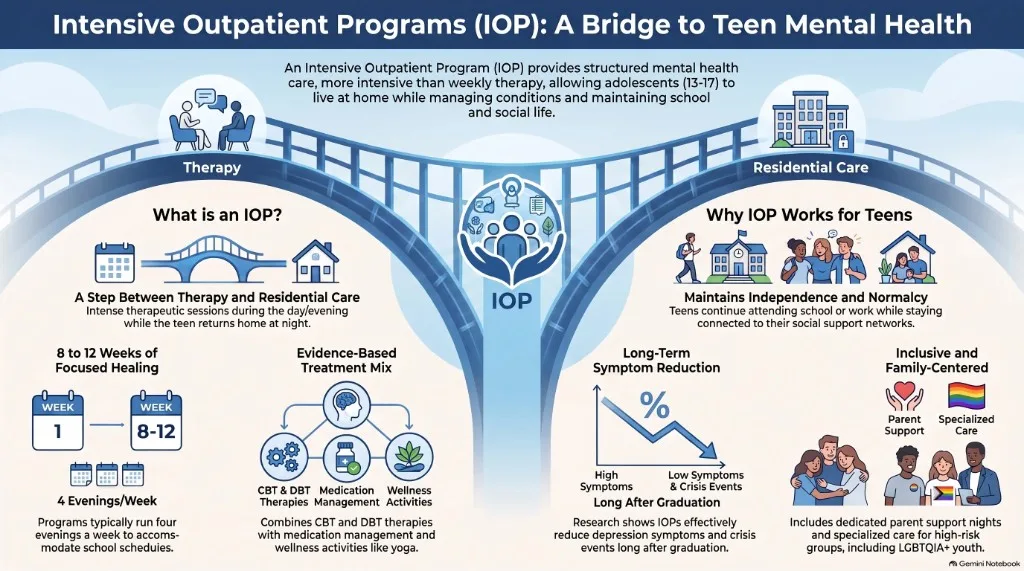
An IOP is a care program for mental health where you traditionally attend therapeutic sessions in-person at a center during the day. Come the evening, you return to your home. It's more intense than weekly therapy but is a step down from a residential care program.
At Hopewell Health Solutions, we have an IOP specifically designed for teenagers aged 13–17. The program runs from our center in Glastonbury for 8 to 12 weeks, Monday to Thursday, 5pm–8pm. We offer both in-person and virtual treatment.
Most IOPs (including ours) integrate evidence-based therapies such as cognitive behavioral therapy (CBT) and dialectical behavior therapy (DBT), with medication management (e.g. for antidepressants and mood stabilizers) if needed, and wellness activities, such as yoga and meditation. Our program additionally has parent night and support for parents to ensure that you are updated on your child's progress and have your own dedicated care.
How Does an IOP Help Teen Mental Health?
From 2006 to 2019, an estimated 145 million teens and young adults sought outpatient care because of a mental health condition. There are many reasons why there's greater engagement with mental health care among teens, including a growing mental health crisis among the demographic, as well as greater awareness around, and access to, mental health resources.
In fact, research shows that IOPs have helped meet the increasing needs for youth mental health services since the COVID-19 pandemic.
IOP is a popular form of care for teens because they can continue to attend school or work part-time while they receive treatment. The flexible timing and the ability to go home in the evening mean that they can maintain a sense of independence and normalcy that is not only crucial to their recovery, but also to their development as young human beings.
Similarly, with an IOP, teens can stay connected to their personal and social support networks, seeing family and friends regularly, which can actually help their engagement in the program and foster their general well-being.
IOPs have also repeatedly been shown to effectively reduce depression symptoms and crisis events and improve overall functioning. And studies highlight that gains made for mental health disorders such as depression are generally maintained after finishing an IOP. LGBTQIA+ youth, who have a high risk of suicide, have demonstrated promising improvements to depressive symptoms when being discharged from an IOP.
What Are the Benefits of a Virtual IOP?
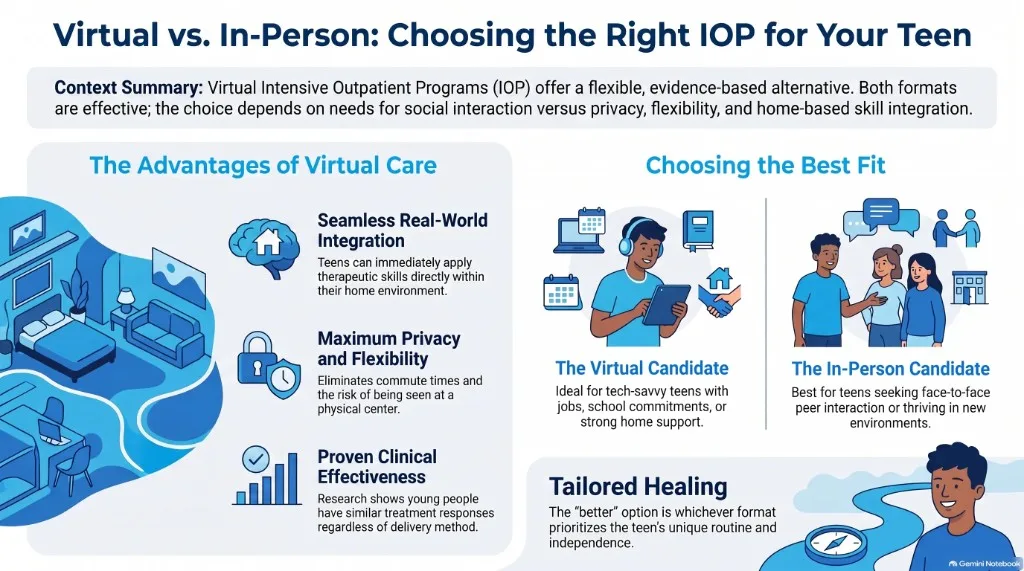
Virtual IOPs are offered by health centers that recognize people may have difficulty traveling to and from facilities for treatment, or people who respond better (or are more accustomed to) telehealth services. Young people, specifically, are tech-savvy enough to navigate virtual care with ease and comfort.
Beyond being accessible, virtual IOPs have many benefits for teens, including:
- Remove commute times to and from the center
- Offer even greater flexibility to study and work while undergoing care
- Greater privacy (take sessions from preferred places, no risk of being seen while going to the health center)
- Access care from a familiar home space, which can heighten the effectiveness of care
- Integrate skills and takeaways from virtual sessions directly into the home environment
- Therapists can utilize interactive digital tools in sessions
Research notes that young people showed similar responses to treatment regardless of whether IOP was delivered in person or via telehealth. However, during the pandemic, virtual IOPs supported improvements in mental health for young people, as well as helped lower mental-health-related emergency department admissions during that time.
A separate study shows that young people experience recovery more in terms of their ability to "return to normal" than in terms of reductions in clinical symptoms. A virtual IOP could facilitate "returning to normal" more than in-person treatment, because teens are in their home environments and can immediately apply therapeutic learnings.
What Are the Limitations of a Virtual IOP?
Despite being a proven form of care, there are some limitations to a virtual IOP for teens. For one, it can exclude teens and their families who don't have access to the internet or who don't have the necessary technology and skills. It may also not help to resolve feelings of isolation that are often present with mental health disorders.
One study found that peer relationships are important both within and outside of IOPs for young people. A virtual IOP doesn't provide participants with the opportunity to meet fellow youths struggling with mental health face-to-face. Notably, young people said they wanted to feel supported by, engage with, and have positive experiences with their peers inside and outside of the treatment setting.
Is an In-Person IOP "Better" Than the Virtual Option?
Neither option is necessarily "better". Both have their merits, and both are effective at treating mental health disorders. Like any form of behavioral care, the most important thing is that treatment is tailored and is right for the person receiving it.
A virtual IOP may suit a teen who doesn't drive, who has a job, who is studying for finals, or who has a strong support network in their home setting. Alternatively, an in-person IOP may suit a teen who seeks more social interaction or who thrives in new settings.
If you're considering an IOP for your teen, speak with them first about what format prioritizes their healing but also factors in their independence, existing routine, and communities.
Virtual and In-Person IOP for Teens at Hopewell Health Solutions, Connecticut
Our dedicated teen IOP (for ages 13–17) treats young people suffering with their mental health. All our care is tailored to each person, taking into account their medical history, current situation, future plans, and unique challenges in the world.
We have a team of licensed clinicians who provide evidence-based therapies, medication management, and strive to always prioritize teens' comfort and progress. We also have different mindfulness practices to nurture physical and mental well-being and to keep young people engaged with treatment for longer-lasting outcomes.
Our center in Glastonbury hosts our teen IOP and is fully equipped for in-person sessions or virtual sessions.
There's always hope to heal. Speak with our admissions team now.
Sources
- McGorry, P. et al. (January 2025). The youth mental health crisis: analysis and solutions. Frontiers.
- Ahn-Horst, R. & Bourgeois, F. (March 2024). Mental Health-Related Outpatient Visits Among Adolescents and Young Adults, 2006-2019. JAMA Network Open.
- Newkirk, C. et al. (August 2025). Higher Levels of Care in Young Adult Mental Health. Current Psychiatry Reports.
- Evans-Chase, M. et al. (April 2023). Treating Depression in Adolescents and Young Adults Using Remote Intensive Outpatient Programs: Quality Improvement Assessment. JMIR Formative Research.
- Burton, M. et al. (April 2022). The role of depression in the maintenance of gains after a prolonged exposure intensive outpatient program for posttraumatic stress disorder. Depression and Anxiety.
- Berry, K. et al. (April 2023). LGBTQIA+ Adapted Telehealth Intensive Outpatient Program for Youth and Young Adults: Subgroup Analysis of Acuity and Improvement Following Treatment. JMIR Formative Research.
- Bero, K. et al. (2025). Treatment Outcomes of an Adolescent Intensive Outpatient Program for Depressed and Suicidal Youth. JAACAP Open.
- Gliske, K. et al. (November 2023). Reduction of Mental Health-Related Emergency Department Admissions for Youth and Young Adults Following a Remote Intensive Outpatient Program: Quality Improvement Analysis. JMIR Formative Research.
- Evans-Chase, M. et al. (May 2023). Understanding Treatment Needs of Youth in a Remote Intensive Outpatient Program Through Solicited Journals: Quality Improvement Analysis. JMIR Formative Research.
Written by

TJ Aitken, CPSRP
Director of Business Development
A person in long-term recovery, TJ brings both lived experience and professional expertise to his work in the substance use and recovery field. As a Certified Peer Support and Recovery Professional (CPSRP) and Recovery Coach Professional, he has spent the past 10 years working in the substance use field, supporting individuals and families through compassionate, recovery-oriented care. His work is grounded in the belief that recovery is possible, sustainable, and strengthened through connection and community.
Read Full Bio →Medically reviewed by Kristine Schlichting, PhD, Director & Founder.