

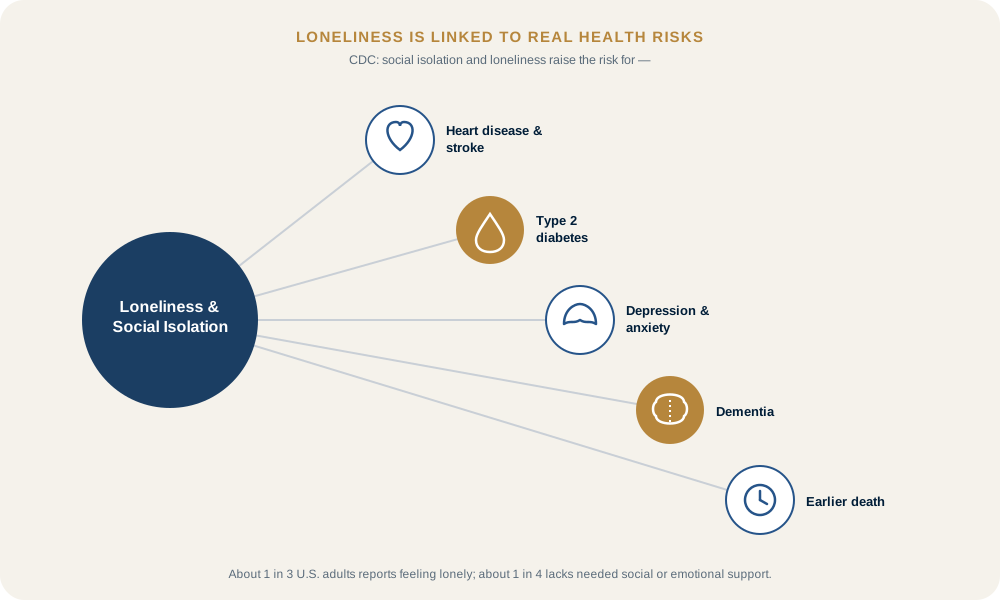
About one in three adults in the United States reports feeling lonely, and about one in four report not having the social and emotional support they need. Meaningful relationships are built from specific, learnable parts: trust, emotional safety, mutual respect, honest communication, and boundaries. When loneliness, trauma, or compulsive behavior interferes, those parts can be rebuilt.
What Makes a Relationship Meaningful?
A meaningful relationship is not defined by how long it has lasted or how little conflict it contains. It is defined by whether both people feel safe being known.
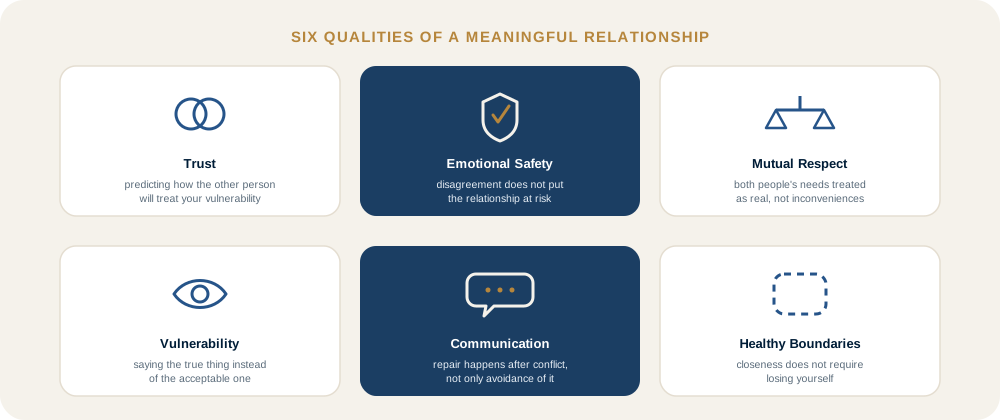
Six qualities of a meaningful relationship include:
- Trust, meaning you can predict how the other person will treat your vulnerability.
- Emotional safety, meaning disagreement does not put the relationship at risk.
- Mutual respect, meaning both people treat the other person's needs as real rather than as inconveniences.
- Vulnerability, meaning you say the true thing instead of the acceptable one.
- Communication, meaning repair happens after conflict, not only avoidance of it.
- Healthy boundaries, meaning closeness does not require losing yourself.
None of these are personality traits. They are practices, which is why they can be learned late and rebuilt after damage.
What Is Emotional Safety in a Relationship?
Emotional safety is the sense that honesty will not be punished. In practice, it sounds like being able to say "that hurt me" and receiving curiosity rather than defensiveness or withdrawal.
People in recovery often recognize this last. Safety was the missing ingredient, not effort.
Why Do Boundaries Bring People Closer?
Boundaries name what you can offer and what you cannot. Without them, resentment builds quietly, and resentment corrodes intimacy faster than open conflict does.
A person who cannot say no cannot be fully trusted when they say yes.
How Loneliness Interferes With Connection
Loneliness is not only painful. The Centers for Disease Control and Prevention (CDC) links social isolation and loneliness to higher risk for heart disease and stroke, type 2 diabetes, depression and anxiety, dementia, and earlier death.
It also shapes behavior. Among 427 adults studied by the National Institute on Alcohol Abuse and Alcoholism (NIAAA), those with a history of Alcohol Use Disorder (AUD) reported greater loneliness than participants without one, and that loneliness was linked to higher anxiety and depressive symptoms.
Substance use can begin as a solution to loneliness and end as its cause. Relief arrives quickly, withdrawal from people happens gradually, and eventually the substance becomes the most reliable relationship in the room.
Can You Feel Lonely in a Relationship?
Yes. Loneliness reflects the distance between the connection a person has and the connection they need, which is why someone with a full household can still feel it.
Two people can share an address, a schedule, and a bed and still not be known to one another.
How Trauma and Attachment Difficulties Shape Closeness
Early relationships teach the nervous system what closeness costs. When care is unpredictable, intimacy can register as exposure. The safest move becomes either pursuing reassurance constantly or keeping everyone at arm's length.
Trauma in adulthood does the same thing more sharply. Couples in which one partner has Post-Traumatic Stress Disorder (PTSD) report lower relationship satisfaction, less intimacy, and less communication than couples without it. The effect runs in both directions, so relationship distress can worsen symptoms while symptom relief can improve the relationship.
That has a practical consequence. Treating trauma is relationship work, and improving the relationship is part of trauma work.
Why Does Getting Close Feel Unsafe After Trauma?
Because the responses that once provided protection, including numbing, vigilance, and withdrawal, are the opposite of what closeness requires.
Detachment rarely means indifference; it means a nervous system still standing guard over a threat that has already passed.
When Compulsive Behaviors Replace Intimacy
Some behaviors deliver the sensation of connection without the exposure of being seen. Alcohol, other substances, pornography, gambling, overwork, and endless scrolling all qualify.
The signal to watch is not frequency. It is displacement: whether the behavior now occupies the time, attention, and honesty the relationship used to receive.
Does Pornography Use Affect a Relationship?
It depends on the pattern. Problematic pornography use is not recognized as a standalone disorder in the Diagnostic and Statistical Manual of Mental Disorders, and most use does not meet any clinical threshold.
In the adult United States population, however, as many as 11% of men and 3% of women report feeling addicted to pornography, and roughly one in eight men who use it report wanting professional help for compulsive use.
Where it does damage a relationship, secrecy is usually the mechanism rather than the content. Hiding requires managing what a partner knows, and managing a partner is incompatible with being close to them.
How Does Phone Use Affect Emotional Closeness?
An overview of 52 studies covering nearly 19,700 participants found that being set aside by a partner in favor of a phone is associated with lower relationship satisfaction, reduced intimacy, less perceived responsiveness, and more conflict and jealousy.
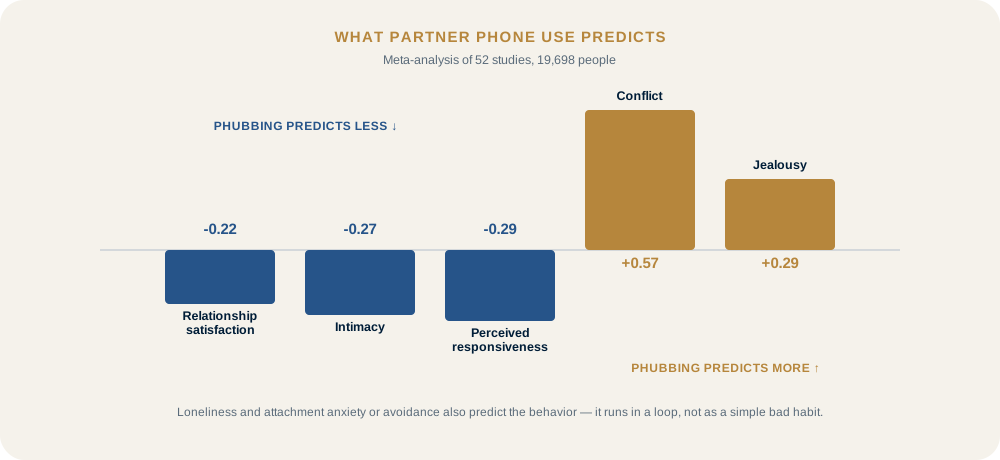
Loneliness, attachment anxiety, and attachment avoidance also predicted the behavior, which makes it a loop rather than a simple bad habit.
Practical Ways to Rebuild Intimacy
Rebuilding intimacy is cumulative rather than dramatic. These moves are small on purpose:
- Protect one short window of undivided attention each day. Twenty minutes, phones in another room, no logistics or scheduling talk.
- Trade defense for repair. Apologize for the specific impact rather than explaining the intent.
- Say the smaller true thing early, when it is still a preference, instead of waiting until it becomes a grievance.
- Rebuild shared activity, not just shared conversation. Doing something together lowers the pressure that face-to-face talks can create.
- Widen the circle. One relationship cannot carry every need, and friendships reduce the strain a partnership has to absorb.
- Name the behavior instead of the character. "I felt alone last night" opens a conversation that "you never care" closes.
How Long Does It Take to Rebuild Trust?
Longer than an apology and shorter than most people fear. Trust returns through accumulated evidence: keeping small promises, telling the truth when it is uncomfortable, and staying consistent through the weeks when nothing feels settled.
There is no fixed timeline. There is a pattern, and partners usually feel the pattern turn before they can explain why.
When Individual, Couples, or Family Therapy Helps
The right starting point depends on where the problem currently lives.
- Individual therapy fits when active substance use, untreated trauma, depression, or anxiety is making steady conversation impossible.
- Couples therapy fits when both partners want the relationship and the difficulty sits in the pattern between them, including communication, secrecy, mismatched needs, or a breach of trust.
- Family therapy fits when household roles have organized themselves around one person's illness or when children are absorbing tension nobody has named.
Family involvement carries measurable weight in addiction treatment. Family counseling is positively associated with higher treatment engagement and retention, better cost effectiveness, and improved outcomes for clients and their families.
It can also motivate a person to enter or remain in treatment and reduce the risk that children in the household develop substance use or mental health conditions of their own.
What Matters Most
- Meaningful relationships rest on trust, emotional safety, mutual respect, vulnerability, communication, and boundaries, all of which are learnable practices rather than fixed traits.
- About one in three U.S. adults reports loneliness, and a history of Alcohol Use Disorder is associated with greater loneliness, higher anxiety, and more depressive symptoms.
- Trauma and attachment difficulties reduce intimacy in both directions, so treating symptoms and repairing the relationship reinforce each other.
- Compulsive behaviors harm closeness mainly through secrecy and displacement, and phone use during shared time is associated with lower satisfaction and less intimacy.
- Individual therapy suits active symptoms, couples therapy suits the pattern between two people, and family counseling is linked to stronger engagement, retention, and outcomes in addiction treatment.
There Is Hope to Heal
If connection has become difficult, Hopewell Health Solutions provides individual, couples, and family counseling across six Connecticut locations, including Glastonbury, West Hartford, East Hampton, and Westbrook, plus telehealth statewide.
Our couples work uses The Gottman Method, and our clinicians are trained in approaches including Cognitive Behavioral Therapy (CBT), Eye Movement Desensitization and Reprocessing (EMDR), and Attachment-Based Family Therapy. We are a Joint Commission-accredited practice serving Connecticut clients since 2013.
When substance use or a co-occurring condition is part of the picture, our Intensive Outpatient Program (IOP), Partial Hospitalization Program (PHP), and medication management sit under the same roof.
Connection is a skill, and skills can be rebuilt. Speak with admissions today. Call (860) 735-1448.
Sources
- Centers for Disease Control and Prevention. (2024, May 15). Health Effects of Social Isolation and Loneliness. Centers for Disease Control and Prevention.
- Luk, J.W., et al. (2024, Feb. 27). Associations of History of Alcohol Use Disorder With Loneliness, Social Support, and Mental Health During the COVID-19 Pandemic. Psychiatry Research, 335, Article 115826.
- Cannon, C.J. and Gray, M.J. (2024, Jul. 26). A Caregiver Perspective for Partners of PTSD Survivors: Understanding the Experiences of Partners. Behavioral Sciences, 14(8), Article 644.
- Dubois, C., et al. (2025, Nov. 12). Substance Use Patterns Among Individuals With Problematic Pornography Use: A Scoping Review. PLOS Global Public Health, 5(11), Article e0004946.
- Ni, N., et al. (2025, May 13). A Meta-Analytic Study of Partner Phubbing and Its Antecedents and Consequences. Frontiers in Psychology, 16, Article 1561159.
- Substance Abuse and Mental Health Services Administration. (2020). Chapter 1—Substance Use Disorder Treatment: Working With Families. Treatment Improvement Protocol (TIP) Series, No. 39. Substance Abuse and Mental Health Services Administration.
Written by

TJ Aitken, CPSRP
Director of Business Development
A person in long-term recovery, TJ brings both lived experience and professional expertise to his work in the substance use and recovery field. As a Certified Peer Support and Recovery Professional (CPSRP) and Recovery Coach Professional, he has spent the past 10 years working in the substance use field, supporting individuals and families through compassionate, recovery-oriented care. His work is grounded in the belief that recovery is possible, sustainable, and strengthened through connection and community.
Read Full Bio →Medically reviewed by Kristine Schlichting, PhD, Director & Founder.