
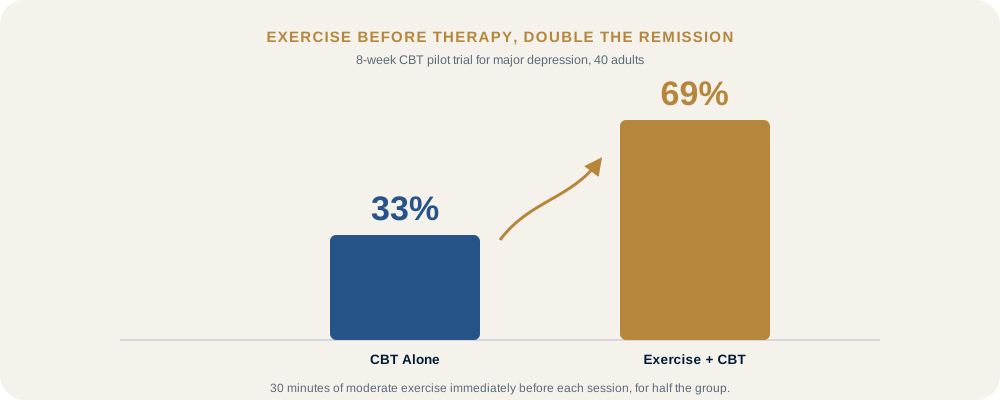
Adults with major depression who exercised for 30 minutes immediately before each therapy session reached remission at 69%, compared with 33% for a matched group who did not, in a 2026 pilot trial. Supporting dopamine naturally is a question of ordinary behavior, repeated over weeks. No supplement produces a result like that.
What Does Dopamine Do?
Dopamine is a chemical messenger built from the amino acid tyrosine. It is produced mainly in two midbrain regions, the substantia nigra and the ventral tegmental area.
It is often called the pleasure chemical. That description is out of date: dopamine has more to do with reinforcing behaviors so that they are repeated than with generating pleasure itself. Weakened signaling therefore does not feel like sadness. It feels like difficulty starting, reduced anticipation, and effort that no longer seems worth it.
More dopamine is also not better. Dysregulated dopamine signaling causes problems in both directions, whether it is elevated or reduced. Excessive dopamine activity is a feature of psychosis and stimulant misuse, so the goal is a balanced system, not one pushed as high as possible.
Can You Test Your Dopamine Levels?
Not in any way that answers this question. Blood and urine tests do exist, but they are ordered to diagnose tumors. There is no office test for dopamine signaling in the brain, and no diagnosis called dopamine deficiency. What can be assessed is the symptom.
Which Habits Support Dopamine Function?
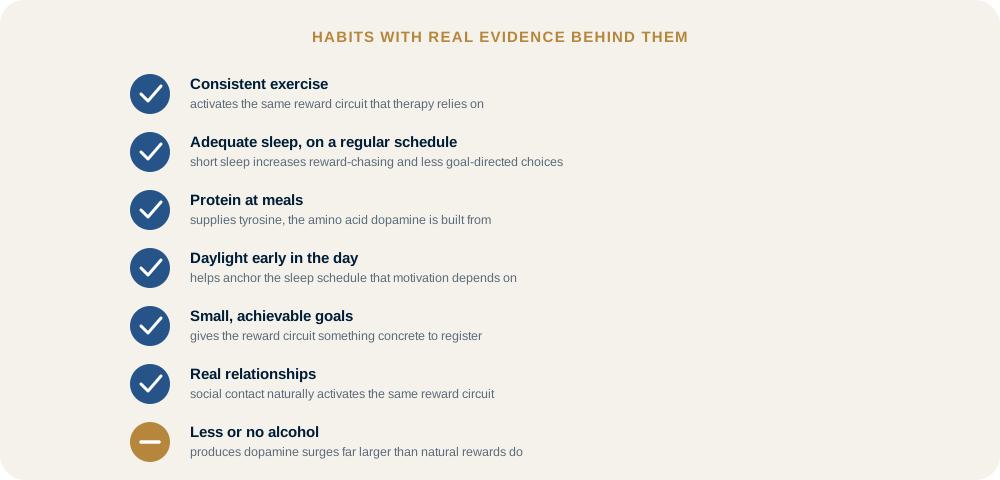
No single habit raises dopamine on command. Several behaviors do influence motivation and the brain's reward system, and they overlap almost entirely with what supports depression treatment:
- Consistent exercise
- Adequate sleep on a regular schedule
- Protein at meals
- Daylight early in the day
- Small achievable goals
- Real relationships
- Less or no alcohol — it produces dopamine surges far larger than natural rewards do.
Does Exercise Increase Dopamine?
In the pilot trial above, 40 adults with major depression received eight weeks of Cognitive Behavioral Therapy (CBT), and for half of them every session was preceded by 30 minutes of moderate exercise. That group showed greater behavioral activation and a higher remission rate.
The practical version: the hour after a workout is often the easiest window in a day for something demanding, including therapy.
How Does Sleep Affect Motivation?
Short sleep does not switch reward off. It changes what a person reaches for. In a study of 36 healthy adults, seven nights of five hours in bed, compared with seven nights of nine hours, increased sensitivity to reward feedback and made decisions less goal-directed.
Why Do Small Goals and Relationships Matter?
When the reward circuit registers something worthwhile, dopamine marks the moment as worth remembering, which makes the behavior easier to repeat. Goals that are too large give it nothing to register: a week of unfinished intentions returns no feedback, while one completed 20-minute task does.
Social interaction is one of the healthy rewards that naturally activates the same circuit. Isolation removes a recurring source of it, which is why low motivation deepens when someone withdraws. For families, regular contact that does not require the person to perform, such as going on a walk or dinner, works better than encouragement to cheer up.
Do Foods or Supplements Raise Dopamine?
Food supplies the raw material. Dopamine is synthesized from tyrosine, present in most protein sources, including meat, fish, eggs, dairy, soy, and legumes. Supplying a precursor is not the same as raising dopamine on demand.
Supplements marketed as dopamine boosters are not approved treatments for depression, Attention-Deficit/Hyperactivity Disorder (ADHD), or any other condition, and some interact with psychiatric medication.
How Do You Reduce Reliance on Constant Digital Stimulation?
The concern is not screen time as a number. It is that hours of short-form video, feeds, and games supply frequent, effortless rewards, which makes slower activities feel not worth starting.
Adjustments families can make together:
- Keep phones out of the bedroom, which protects sleep and the morning hour at the same time.
- Pick one specific habit to cut rather than attempting a full detox, since smaller changes hold.
- Watch for use that continues despite consequences, which is a different problem than a bad habit.
When Low Motivation Is a Symptom
Low drive that persists is often a clinical symptom rather than a lifestyle problem. Anhedonia, the reduced ability to feel interest or pleasure, occurs in 35% to 70% of people with Major Depressive Disorder (MDD). It appears across other psychiatric conditions and is associated with suicidality.
How Can Families Tell the Difference?
Families are often the first to notice, and the pattern tells you more than the symptom does.
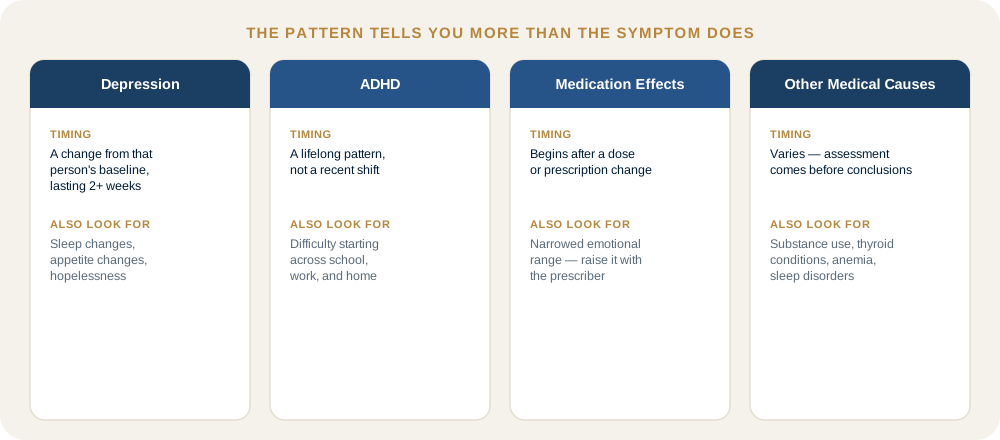
- Depression is a change from that person's baseline lasting more than two weeks, usually alongside sleep changes, appetite changes, or hopelessness.
- ADHD is a lifelong pattern rather than a recent shift, and difficulty starting shows up across school, work, and home.
- Medication effects begin after a dose or prescription change, and some antidepressants narrow emotional range. Raise this with the prescriber rather than stopping on your own, because abrupt discontinuation carries risks.
- Substance use, thyroid conditions, anemia, and sleep disorders produce the same flatness, which is why assessment comes before conclusions.
You do not need to work out which one it is. Naming the change out loud, without accusation, is usually the most useful thing a family member does.
When Should Someone Talk to a Professional?
- Flat motivation has lasted more than two weeks and has not lifted with rest.
- Work, school, or parenting is slipping despite real effort.
- Activities once enjoyed no longer register, and contact with close people is dropping off.
- Drinking, substance use, or hours of scrolling have become ways to feel something.
If low motivation has turned into thoughts of suicide, get help now. The 988 Suicide and Crisis Lifeline is available in the United States by call or text, around the clock.
How Treatment Addresses Low Motivation
Treatment begins with an assessment to identify what is producing the symptom, because depression, trauma, ADHD, and substance use each call for a different plan. From there, several approaches apply:
- Behavioral activation, which restores activity first and lets motivation follow.
- CBT for the thinking patterns that prevent starting, and Dialectical Behavior Therapy (DBT) for emotional regulation and follow-through.
- Eye Movement Desensitization and Reprocessing (EMDR) and Accelerated Resolution Therapy (ART) when trauma is driving the flatness.
- Psychiatric medication management, informed by GeneSight® testing where useful.
- Group therapy, which addresses the isolation that low motivation deepens.
When therapy and medication have not been enough, Transcranial Magnetic Stimulation (TMS) is worth discussing. In 144 adults with treatment-resistant depression, a standard course of TMS produced significant improvement in anhedonia, and patients with severe anhedonia at the start were as likely as anyone else to respond or reach remission.
At Hopewell Health Solutions, care can step up or down without changing teams. We offer weekly counseling, an Intensive Outpatient Program (IOP), and a Partial Hospitalization Program (PHP).
What Matters Most
- Dopamine reinforces behavior more than it produces pleasure, so low signaling feels like low drive rather than sadness, and the goal is steady function rather than maximum dopamine.
- No home or office test measures brain dopamine, and no supplement raises it reliably.
- Exercise, sleep, protein, morning daylight, small goals, real relationships, and less constant digital stimulation are the levers with actual support behind them.
- A dopamine detox does not reset brain chemistry, though cutting one compulsive habit is worth doing on its own merits.
- Flat motivation lasting more than two weeks warrants an assessment, because depression, ADHD, and medication effects each call for a different plan.
There Is Hope to Heal
If motivation has been gone long enough that you have started researching brain chemistry, for yourself or for someone in your family, it is worth a conversation with a clinician.
Hopewell Health Solutions provides outpatient mental health care from six Connecticut locations, including Glastonbury, West Hartford, East Hampton, and Westbrook, plus telehealth statewide.
More than 50 licensed clinicians, prescribers, psychologists, and therapists work with us, and we are a Joint Commission accredited practice serving Connecticut clients since 2013.
Motivation comes back with treatment, not with willpower alone. Whether you are asking for yourself or for someone you love, admissions will walk you through the next step. Call (860) 735-1448.
Sources
- Meyer, J.D., et al. (2026). Exercise Priming to Enhance Therapeutic Bond and Behavioral Activation in CBT for MDD: A Randomized Controlled Target-Engagement Trial With Remission Signal. Journal of Affective Disorders, 405, Article 121606.
- Khalil, B., et al. (2024). Physiology, Catecholamines. StatPearls. StatPearls Publishing.
- National Institute on Drug Abuse. (n.d.). Drugs and the Brain. National Institute on Drug Abuse.
- Lim, J.Y.L., et al. (2025). Sleep Restriction Increases Reward Sensitivity During Sequential Updating. Sleep, 49(3), Article zsaf354.
- Desai, D., et al. (2024). A Literature Review on Holistic Well-Being and Dopamine Fasting: An Integrated Approach. Cureus, 16(6), Article e61643.
- Al-Soleiti, M., et al. (2025). Anhedonia as a Core Symptom of Depression and a Construct for Biological Research. Focus, 23(2), 163-172.
- Fukuda, A.M., et al. (2021). Effects of Transcranial Magnetic Stimulation on Anhedonia in Treatment Resistant Major Depressive Disorder. Brain and Behavior, 11(9), Article e2329.
Written by

Teesha Huertas, LCSW
Clinic Director & Licensed Clinical Social Worker
Teesha is a Licensed Clinical Social Worker who graduated from UConn with her BA in Psychology and Master's in Social Work. Teesha has been in the Behavioral Health field for a decade now and has worked in a variety of settings. Teesha's clinical experience has come from working as a case manager, inpatient and outpatient clinician, crisis worker, and clinical director in Substance Use Rehabilitation Programs. Teesha is an experienced leader who leads with compassion, ethics, and discipline. She believes in guiding and motivating the people she works with to develop the skills necessary for strategic decision making and the execution of goals and growth.
Read Full Bio →Medically reviewed by Kristine Schlichting, PhD, Director & Founder.